
J. Chester Armstrong
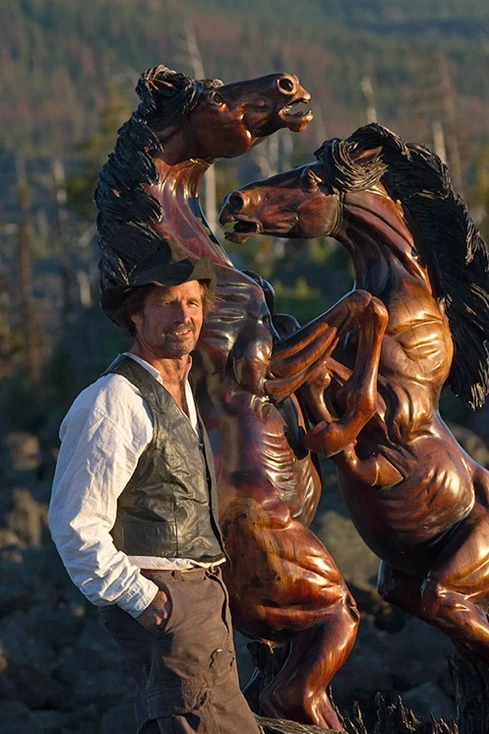
J. Chester Armstrong is an American sculptor recognized for monumental works in wood that capture the movement, power, and spirit of the natural world. For more than five decades, Armstrong has transformed massive timbers into expressive works ranging from intimate wildlife sculpture to large-scale architectural and public-art installations.
Born and raised in Berkeley, California, Armstrong studied Poetic Theory and Philosophy at the University of California, Berkeley. Early travels through Central America and an interest in ancient carving traditions helped shape his understanding of sculpture and the narrative possibilities of wood. He eventually settled in Central Oregon in the 1970s, drawn to the open landscape and wild character of the American West.
Largely self-taught as a sculptor, Armstrong developed a distinctive approach he describes as “slightly stylized realism.” His work is grounded in recognizable form while emphasizing rhythm, gesture, movement, and silhouette over strict anatomical representation. Horses—particularly powerful, interconnected herds—have become among his most recognizable subjects, alongside eagles, wolves, cougars, coyotes, and other inhabitants of the Western landscape.
Working primarily in native and regional woods, including ponderosa pine, juniper, maple, and walnut, Armstrong approaches sculpture as both an artistic and intensely physical process. Chainsaws establish the initial form; grinders, routers, chisels, and hand tools progressively reveal increasingly refined surfaces and detail. Rather than treating wood as a neutral material, Armstrong allows the grain, mass, irregularities, and history of each tree to participate in the composition.
His body of work extends well beyond freestanding sculpture. Armstrong has created monumental doors, carved columns, architectural reliefs, story poles, and site-specific installations for private residences, resorts, churches, corporations, and public spaces throughout the United States. Among his notable works are monumental carved cathedral doors and ecclesiastical installations, as well as large-scale narrative and architectural works created for significant public and private settings.
In 2026, Armstrong was selected for a major public-art commission for Redmond Municipal Airport in Central Oregon. The multi-part project includes a monumental 21.5-foot story pole, large-scale wildlife imagery, and sculptural relief elements developed specifically for the airport environment. The commission continues Armstrong’s longstanding exploration of wildlife, landscape, regional history, and the relationship between sculpture and place.
Armstrong continues to undertake select monumental public and private commissions while creating one-of-a-kind sculpture for gallery and private collections. His work can be found in private, corporate, ecclesiastical, resort, and public collections throughout the United States.
At the center of Armstrong’s work is a conviction that sculpture can reconnect the viewer with something elemental. Wood retains evidence of the living tree even after it has been transformed; through movement, form, and narrative, Armstrong seeks to preserve that vitality in each finished work.
“I carve to reawaken the soul of the viewer to the primal energy and life force of earth-based imagery.”
— J. Chester Armstrong
Armstrong continues to live and work near Sisters, Oregon, where the forests, wildlife, and expansive landscapes of the American West remain an enduring source of inspiration.