
Jordan Daines
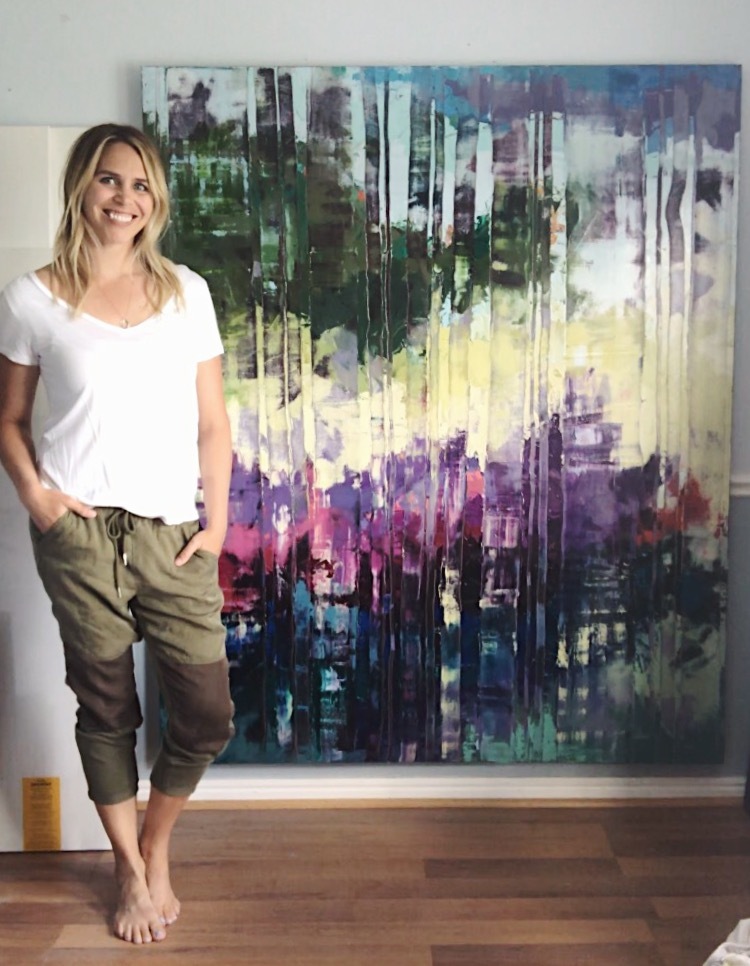
Local Utah artist, Jordan Daines was born in Arizona, 1980. She primarily works with oil on wood panels or canvas, using thick layers of paint and masterful strokes with the knife to achieve highly textured, three-dimensional pieces with vibrant, colorful gradients which produce a sense of fractalization in both the aspen-like images and diverging hues on the canvas.
As the viewer takes in Jordan Daines’s art, we see the depth in the layers of paint, understanding the hours that each piece not only requires to create, but to dry, as well. We feel a deep connection to her and the abstract nature that her paintings elicit.
Jordan Daines received her Bachelor of Fine Arts in Painting from Caine College of the Arts. During this period, she studied in Florence, Italy under Marsi Haysaam, enhancing her knowledge of art and its discourse.
From a young age, Jordan Daines started painting and won both a Congressional Art Award and was named the National Art Education Association Student of the year. Her work has been included in numerous shows, both group and solo, is held in private collections and has appeared in many film and television programs including “Two Broke Girls” and “Big Little Lies”.
“My paintings are an emergent operation of form and color. A relationship develops as I respond to each application of paint. There are no accidents. I'm finished when I sense that agreement has been accomplished. Inherent within my process is always a continual oscillation between reaction and anticipation. Color is not the medium, rather, color is the interface between the medium and the user. Through the medium of painting, color indexes and represents the world as we understand it. On the other hand, color also holds within it the ability to be projective, to propose new worlds and new possibilities. My current work has undertaken the opportunity to explore these two polar possibilities simultaneously. Moving between representation and abstraction, from scale to scale-less. Does the added context that representation provides add interest? Does the projection of new worlds and forms through abstraction provide needed escape or new thought? Or, in the end is it all just color to look at?”